Revised principal findings
GA4 confirms checkout and purchase activity. The recorded checkout losses occur before payment, while substantial losses also occur earlier in the shopping journey. The current evidence supports investigating shipping and cart friction, correcting obvious trust and product-information defects, and validating measurement. It does not establish that poor sales language caused abandonment or that the payment processor is broken.
This revision adds authenticated GA4 report data reviewed October 2, 2026. Storefront tests and content observations were performed October 1. The GA4 property is www.legacysips.com, property ID 538258036, measurement ID G-RLQBD4XKBZ. Earlier statements that analytics were inaccessible or event receipt was unverified are superseded by this review.
Full-period GA4 events: July 1–September 26, 2026
| GA4 event | Event count | Total users | Interpretation |
|---|---|---|---|
| begin_checkout | 33 | 27 | Some users started checkout more than once. |
| add_shipping_info | 32 | 9 | Repeated shipping events are concentrated among a small number of users. |
| add_payment_info | 10 | 7 | Payment-step receipt is confirmed. |
| purchase | 11 | 11 | GA4 attributed $396.80 in total revenue to purchase events. |
Event counts are occurrences; total users are people as identified by GA4. Neither is a verified count of unique checkout sessions or Shopify abandoned checkout records. The 32 shipping events must not be interpreted as 32 buyers progressing through checkout. Repetition alone does not prove duplicate tracking.
Relationship to the original email
| Period | Reported checkout sessions | Completed orders | Abandoned |
|---|---|---|---|
| July | 15 | 4 | 11 |
| August | 7 | 1 | 6 |
| September through 26 | 14 | 5 | 9 |
| Email total | 36 | 10 | 26 |
Mbugua’s email implies 72.2% abandonment and 27.8% completion. GA4 instead recorded 33 checkout starts and 11 purchase events in the same calendar window. These sources use different measures and have not been reconciled. The ratio 11/33 is not a validated session completion rate. Do not substitute the GA4 event totals for Shopify’s order or session records.
The GA4 funnel warns that detailed history is complete only after August 2. The July aggregate events remain available in the Events report, but the full July checkout sequence cannot be reconstructed from this retained funnel. No claim is made about the integration’s installation date.
Checkout behavior and GA4 evidence
Complete retained checkout window: August 3–September 26
| Sequential checkout step | Users | Loss before next step |
|---|---|---|
| Begin checkout | 15 | 6 of 15, or 40.0% |
| Add shipping information | 9 | 4 of 9, or 44.4% |
| Add payment information | 5 | 0 of 5 |
| Purchase | 5 | End of sequence |
This is a closed, user-based funnel: users must begin at checkout and record each subsequent event in order. Five of 15 completed the full sequence, or 33.3%. Ten did not record the full sequence. This is recorded funnel loss, not a verified count of ten abandoned Shopify orders. The sequence is not constrained to a single session.
All five users recorded at the payment step purchased. That gives no indication of widespread payment-stage failure within these five observed journeys; it does not prove that every payment method, attempt or customer worked. The practical investigation area is entry into shipping and progression from shipping to payment. Price shock, delivery uncertainty, form difficulty, low intent and missing events remain possible explanations.
| Device | Checkout starts | Shipping users | Payment users | Full-sequence purchasers |
|---|---|---|---|---|
| Desktop | 11 | 6 | 3 | 3 |
| Mobile | 4 | 3 | 2 | 2 |
The desktop sequence loses eight of 11 users before payment; mobile loses two of four. These small samples do not support declaring a device defect or comparing conversion rates with confidence.
Event coverage does not perfectly match the full funnel
For August 3–September 26, the Events report records 21 checkout-start events from 15 users, 32 shipping events from nine users, seven payment events from five users, and seven purchase events from seven users, with $266.80 attributed revenue. Only five purchasers appear in the full checkout sequence. Two purchasers therefore are not represented by all four steps in order. Accelerated checkout, missing events or identity continuity could explain the gap; none is confirmed. The pixel collects data, but complete journey coverage still needs validation.
Post-fix activity: September 27–October 1
GA4 records 127 total users, 131 session_start events, 52 product-view events from 38 users, 20 add-to-cart events from eight users, and one checkout-start event from one desktop user. No shipping-information, payment-information or purchase events appear in this period; attributed revenue is $0.00. One checkout start is too little evidence to evaluate the September 26 fix.
The October 1 audit included a desktop mixed-cart checkout visit and no purchase. The sole recorded checkout start may include that diagnostic visit; it has not been matched to a specific event. Treat this period as potentially affected by testing. Recent report totals may also change as processing completes.
Storefront tests performed October 1
| Test | Observed result | Limit |
|---|---|---|
| Product and cart behavior | Coffee and tea added successfully; size and subscription prices changed as expected. | Subscription selection verified; recurring fulfillment not tested. |
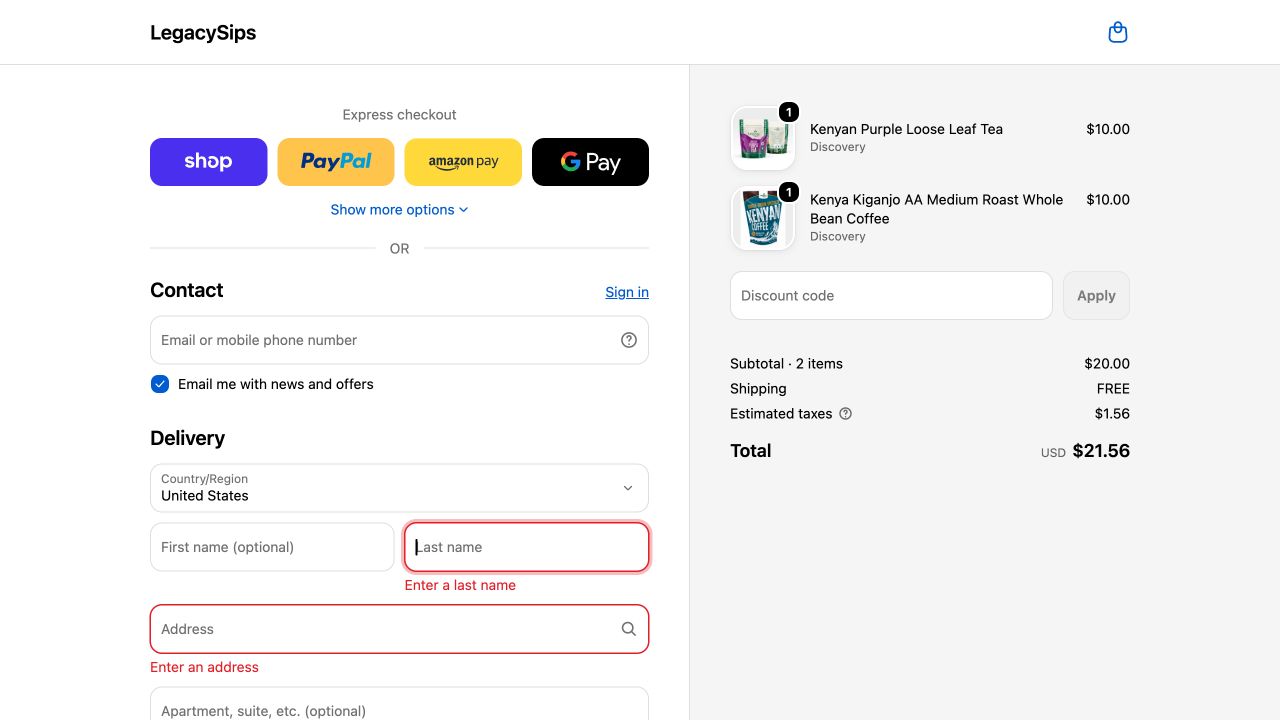
| Desktop and mobile-sized checkout | Guest fields, card fields and express-payment controls loaded; 390 × 844 layout remained usable. | No actual payment or express-wallet transaction submitted. |
| Mixed shipping quote | Two $10 products returned one delivery group and two $0 shipping options to Irvine ZIP 92602. | One basket and destination only. |
| Order summary | $20 subtotal, $1.56 estimated tax, $21.56 total. | Name and street fields deliberately omitted; required-field messages were expected. |
The reported duplicate shipping defect was not reproduced for this basket. That supports the current behavior for this combination and destination, not every shipping profile or the historical fix. No controlled performance benchmark, processor-log review or full destination matrix was performed.
Earlier sales friction and customer confidence
Losses begin before checkout
| Closed purchase-journey step, August 3–September 26 | Users |
|---|---|
| Session start | 998 |
| View product | 212 |
| Add to cart | 30 |
| Begin checkout | 9 |
| Purchase | 5 |
Within this full sequential journey, 182 of 212 product viewers did not record a subsequent cart addition (85.8%), and 21 of 30 cart users did not record a subsequent checkout start (70.0%). These are user-based sequence losses, not overall site conversion rates. The nine checkout starters here differ from the 15 in the checkout-only funnel because this report also requires the earlier session, product and cart steps.
This supports examining the product offer, buyer confidence, traffic quality and cart experience alongside shipping. It does not isolate copy as the cause. Fix clear information defects before testing a broad rewrite, and avoid attributing every missing event to a buyer decision.
Shipping information remains incomplete and inconsistent
On October 1, the Shipping and Returns page had a Shipping policy heading with no policy text. Featured product cards advertised free shipping above $50, while the tested $20 mixed basket qualified for free shipping in Irvine. Confirm the actual regional policy and align every claim with it. State shipping origin, supported destinations, fees or thresholds, dispatch timing and delivery estimates before checkout. This is especially relevant to the observed shipping-stage losses, but causation remains unproven.
Return policy and review displays need correction or substantiation
The return page contained [INSERT RETURN ADDRESS], generic unworn-item and tag language, and perishable/sale exclusions. Publish an accurate process for damaged, incorrect or otherwise eligible returns, using terms Mbugua approves. The three featured products each showed five stars and 127 reviews; review text was not observed on the inspected product pages. Verify the source and product attribution of those counts, or remove unsupported claims. The audit did not establish that the reviews were fabricated.
Quantity and value should be clear beside price
Tea options use Discovery and Full Set, with 1 oz / approximately 10–12 cups and 2 oz / approximately 20–24 cups explained farther down the description. Coffee’s Discovery option is 6 oz, also explained below. Put physical quantity beside each size choice and price. Keep accurate flavor, origin and brewing information. Repair card excerpt fragments such as “tea.Description” and “complex.Description”.
These are concrete clarity and trust repairs. Their conversion effect must be measured after publication; the GA4 data does not prove that any one wording change will improve sales.
Recommended corrective work
Mbugua Karanja is responsible for these actions, directly or through providers he engages. Targets below are suggested relative deadlines from receipt of this revision.
| Priority | Specific action | Suggested target | Definition of done |
|---|---|---|---|
| 1. Shipping and checkout | Confirm the commercial shipping rules; test coffee-only, tea-only and mixed baskets below and above the intended free-shipping threshold in representative supported regions. Include subscription rates if offered. Compare pre-fix abandoned checkout records with actual shipping quotes and payment errors. | Within 72 hours | A dated matrix records expected and actual rates, delivery groups and progression to payment. Shipping claims match the verified rules; any reproducible defect has a documented repair and retest. |
| 2. Buyer confidence and cart clarity | Publish the missing shipping policy and accurate return instructions. Put package quantity beside price and size choices. Substantiate or remove review claims and clean up product-card excerpts. Verify the cart-to-checkout handoff on mobile and desktop. | First corrections within 72 hours; complete within 7 days | Live pages show accurate shipping cost rules, origin, delivery expectations, remedies and quantities. No address placeholder, blank shipping section or unsupported review count remains. |
| 3. GA4 journey validation | Validate G-RLQBD4XKBZ through product view, cart, begin_checkout, add_shipping_info, add_payment_info and purchase on standard and enabled accelerated checkout paths. Reconcile GA4 transaction IDs and values with Shopify order IDs and totals for July 1–September 26. Investigate the two August–September purchasers missing from the full sequence. | Initial reconciliation within 72 hours; complete within 7 days | A reconciliation explains or flags unmatched orders, missing steps, repeated events and identity gaps. Expected events occur once per intended action, with correct item IDs, value, currency and transaction ID. Each validated purchase matches its Shopify order. |
Smallest useful next step
Within 24 hours, export Shopify orders and available abandoned checkouts for July 1–September 26, capture the current shipping-rule configuration, and record one coffee-only, one tea-only and one mixed-basket rate comparison. In parallel, identify GA4 purchase transaction IDs. This produces the first evidence needed to reconcile the numbers and prioritize a specific repair.
Validation boundaries
Use a supported test checkout or a separately authorized, clearly identified test order for purchase-event validation. Keep test orders and diagnostic visits separate from customer performance analysis. Do not promise a guarantee, change shipping economics or process a live payment solely because this report recommends verification.
Change control and feedback loop
Effective with this revision, stop treating GA4 as absent, inaccessible or wholly unverified. Replace that diagnosis with “GA4 receives ecommerce events; complete checkout journey coverage and Shopify reconciliation remain unverified.” Keep the existing integration until testing establishes a specific repair. Do not add a second pixel to address a reporting discrepancy.
Stop publishing blank policy sections, unfinished placeholders and unsupported review claims as each replacement is ready. Replace them with accurate, approved information and record the live change date. Mbugua confirms completion, reviews the initial evidence within 72 hours, and checks customer checkout counts weekly for four weeks. Report counts, dates and unresolved discrepancies with every update. Choose one subsequent commercial test after obvious defects and measurement gaps are addressed.
What the evidence can and cannot establish
| Finding or hypothesis | Evidence now available | Remaining work |
|---|---|---|
| Shipping-stage friction | 15 checkout users → 9 shipping users → 5 payment users in the retained closed funnel; historical duplicate shipping reported by Mbugua. | Match Shopify checkout records to quoted shipping, baskets, destinations and timestamps; reproduce current rates. |
| Payment-stage failure | All five users recorded at payment purchased; storefront payment controls loaded. | Review actual failed payment attempts and processor errors. Five successful recorded journeys do not rule out other failures. |
| Earlier sales friction | 212 product viewers → 30 cart users → 9 checkout starters in the full purchase sequence; visible information and trust defects. | Review acquisition mix, cart behavior and reliable buyer feedback. Measure effects of individual corrections. |
| Incomplete measurement | Seven purchasers but five payment-step users in the retained window; GA4 11 purchases versus email 10 orders across the full period. | Reconcile transaction-level records, test accelerated paths and inspect event repetition and identity continuity. |
| Shipping fix effectiveness | September 27–October 1 has one checkout start and zero purchases, potentially including the audit. | Accumulate genuine post-fix journeys and compare comparable baskets, destinations and sources. |
Avoid false precision
The available data identifies where recorded progression is lost. It does not identify why an individual stopped, establish a session-level abandonment percentage, prove duplicate event firing, or demonstrate that the September 26 repair succeeded across all customers. Completed purchases missing earlier steps may reflect real alternative checkout paths as well as tracking issues. Preserve that distinction when interpreting the funnel.
Use September 27 as the first full post-fix day unless the exact September 26 repair time becomes available. Report genuine customer checkout starts and matched purchases with underlying counts. Separate mixed baskets, shipping regions, device and traffic source where meaningful. Track payment errors and shipping quotes alongside conversion. Small samples may remain inconclusive for several weeks; avoid multiple simultaneous A/B tests.
Access and scope
Authenticated GA4 aggregate Events, Checkout journey and Purchase journey reports were accessed. Shopify administration, historical order and abandoned checkout exports, shipping profile settings and processor logs were not verified in this audit. No payment was submitted, no storefront setting was changed, and no customer reason for abandonment was confirmed. The October 1 test cart was cleared after inspection.
Evidence and source references
GA4 values were read from the authenticated www.legacysips.com property on October 2, 2026. Events report periods: July 1–September 26, August 3–September 26, and September 27–October 1. Closed checkout and purchase funnels were reviewed for August 3–September 26; the checkout funnel was also reviewed after the fix. Screenshots were retained with the audit working materials. Account access is required to open the report links below.
GA4 Events: July 1–September 26
GA4 Checkout journey: August 3–September 26
Mbugua’s September 26 email is the source of the reported 36 checkout sessions, ten completed orders and 26 abandonments, plus the reported shipping-profile repair. It is a private source; underlying Shopify records have not yet been reconciled.
LegacySips homepage · Shipping and Returns · Coffee product · Purple tea product
Official interpretation and validation references
Google Analytics: funnel reports, closed versus open funnels, user counts and retained-data limits. A closed funnel requires entry at the first step and subsequent steps in order; detailed funnel dates outside retained history can be incomplete.
Google Analytics: DebugView event validation · Shopify: Google Analytics 4 setup
These references explain report interpretation and verification methods. They do not independently prove that LegacySips records every event correctly. This revision supersedes the October 1 audit’s analytics-access and event-receipt limitations; storefront observations retain their October 1 date.