Principal finding
The current shopping flow works in the paths tested. No blocking failure was observed when adding coffee and tea, opening the cart, or reaching checkout on desktop and a mobile-sized screen. The strongest current findings concern shipping consistency, unfinished policies, product presentation, and analytics verification. The evidence does not establish that weak sales language caused the reported abandonment.
Mbugua reported a shipping configuration defect and says the shipping profiles were consolidated on September 26. A current $20 mixed cart returned one delivery group with free shipping for Irvine, California. That test supports the fix for this combination and destination; it does not verify every product, subscription, or shipping region.
What the email establishes
The September 26 email reports 36 sessions reaching checkout, 10 completed orders, and 26 abandoned sessions over the reported 90-day period. It identifies duplicate shipping charges on mixed orders as the suspected primary cause. The underlying abandoned checkout records were not supplied with the email.
| Period | Reached checkout | Completed | Abandoned | Completion |
|---|---|---|---|---|
| July 2026 | 15 | 4 | 11 | 26.7% |
| August 2026 | 7 | 1 | 6 | 14.3% |
| September to 26th | 14 | 5 | 9 | 35.7% |
| Total | 36 | 10 | 26 | 27.8% |
The reported abandonment rate is 72.2%. The email rounds the completion baseline to 27%; the exact calculation is 27.8%. One additional completed order changes the overall completion rate by 2.8 percentage points. This is a small sample, so individual losses matter more than apparent month-to-month trends.
September’s reported performance precedes or coincides with the shipping fix. It cannot establish improvement after the fix. The volume also limits what a 30- or 60-day comparison can prove. The total website traffic and acquisition mix remain unknown.
Technical test results
| Test | Observed result | Assessment |
|---|---|---|
| Coffee add to cart | $10 Discovery coffee persisted in the cart. | Passed in tested path |
| Mixed cart | Coffee plus purple tea appeared as two $10 items at checkout. | Passed in tested path |
| Desktop checkout | Guest contact and delivery fields, card fields and express payment controls loaded. | No visible blocker |
| Mobile layout | At 390 by 844 pixels, product options, cart and checkout remained usable. | No obvious layout blocker |
| Tea size selection | Full Set changed the price from $10 to $17. | Passed |
| Subscription selection | 15% offer displayed $14.45 for the $17 size and a monthly delivery option. | Selection verified only |
| Mixed shipping quote | One delivery group, two free options, $0 shipping for ZIP 92602. | No duplicate charge reproduced |
| Payment completion | No payment details entered and no order submitted. | Not tested |
Shipping result and its limits
The rate request used only country, state, city and ZIP code. No customer name, street address, email or payment data was entered. Checkout returned Free Shipping and Standard, both at $0, for the combined $20 basket. The visible summary showed $20 subtotal, $1.56 estimated tax and $21.56 total. Missing-name and missing-address messages were expected because those fields were deliberately left blank.
The rate result cannot establish that the previous defect never occurred or that all shipping profiles now behave correctly. An administrator should compare coffee-only, tea-only and mixed orders at several destinations, below and above the intended free-shipping threshold, including subscriptions if offered.
GA4 is configured in the current storefront
The live storefront contains a Shopify app web pixel configured with GA4 measurement ID G-RLQBD4XKBZ. Its visible script configuration includes page_view, view_item, add_to_cart, view_cart, begin_checkout, add_shipping_info, add_payment_info and purchase mappings. A corresponding Shopify pixel script is present.
This contradicts the email’s current implication that a native GA4 pixel is absent. It does not show when the integration was installed or prove that events reached the intended GA4 property. The distinction is configuration versus confirmed data collection. Do not install a second tracker solely because of the earlier AI review; duplicate tracking could distort the funnel.
Verify the intended property and event receipt in GA4 Realtime or DebugView, then reconcile purchase counts and revenue with Shopify. Shopify and Google document the integration and event verification methods. See the evidence and source references below.
Sales and customer trust findings
Shipping information is incomplete and inconsistent
The live Shipping and Returns page has a Shipping policy heading with no policy text beneath it. Product and cart pages defer shipping cost to checkout. Featured product cards advertise free shipping above $50, while the tested $20 cart qualified for free shipping in Irvine. Confirm the actual regional policy, then align the website with it. The test does not justify raising the threshold or assuming free shipping applies everywhere.
Before asking a first-time buyer to enter contact details, explain eligible destinations, shipping charges or thresholds, dispatch timing and expected delivery. These omissions can create uncertainty about the delivered price and whether goods ship from Kenya or from domestic inventory. Their effect on abandonment remains a hypothesis.
Return terms look unfinished
The return page still contains [INSERT RETURN ADDRESS]. Its generic language refers to unworn items and tags, while also excluding perishable goods and sale items. For a coffee and tea business, that leaves the customer unsure what happens if an order arrives damaged, incorrect or unsatisfactory. Mbugua should confirm the actual remedy and handling process; the published policy should describe it accurately. Do not promise a satisfaction guarantee without his approval.
Review displays require verification
All three featured homepage products display five stars and a count of 127. The reviewed product pages show five stars, but no customer review content appeared in the inspected page text. Identical counts merit a check of the review data and theme. The review did not establish that the counts are fabricated or hardcoded. Connect ratings to verifiable product reviews, or remove unsupported displays.
The purchase area obscures quantity and value
Purple tea’s selection buttons say Discovery and Full Set. The explanation that these mean 1 oz with approximately 10–12 cups and 2 oz with approximately 20–24 cups sits farther down in the description. The coffee option also says Discovery; its 6 oz size appears in the description. Buyers should see physical quantity next to price and size selection.
A useful first edit is to label the tea choices Discovery 1 oz and Full Set 2 oz, with approximate servings nearby. Retain the product’s existing flavor, origin and brewing information. Those descriptions already answer several substantive buying questions. Replacing them with more promotional language is a lower priority than clarifying quantity, shipping and remedies.
Product card excerpts need cleanup
The purple and white tea cards concatenate headings and body text, producing fragments such as “tea.Description” and “complex.Description”. A dedicated short summary would read more naturally. The homepage also splits attention between retail shopping and wholesale inquiries. These are secondary merchandising issues, not proven checkout failure causes.
Recommended corrective work
These are proposed assignments for Don’s selection, not tasks already delegated or changes already authorized. The client goal is to improve completion of legitimate retail checkouts while keeping product and fulfillment promises accurate. Don owns the overall decision and receives the evidence from each owner.
| Priority | Next action | Proposed owner | Deadline |
|---|---|---|---|
| 1 | Confirm shipping policy and validate a destination and basket matrix. | Jen Villadolid | October 5 |
| 1 | Confirm return remedies, shipping origin and dispatch expectations. | Mbugua Karanja | October 5 |
| 1 | Verify GA4 event receipt and reconcile purchase totals. | Jen Villadolid | October 5 |
| 1 | Collect abandoned checkout export and post-fix counts. | Chari Villa-Real | October 5 |
| 2 | Repair policy text, size labels, card summaries and review displays after approval. | Jen Villadolid | October 8 |
| 2 | Review findings and choose the next commercial test. | Don Ho | October 9 |
Definitions of done
Shipping is complete when a recorded matrix shows the actual rates for single-category and mixed baskets, the intended free-shipping rules, supported regions and subscription behavior. Each customer-facing statement must agree with the approved rules. The commercial policy decision belongs to Mbugua; Jen owns technical verification.
Analytics is complete when the expected product, cart and checkout events appear in the intended GA4 property with correct product IDs, values and currency, and purchase totals can be reconciled to Shopify. Use an approved test environment or separately authorized transaction to validate purchase receipt. A configured pixel alone does not close this item.
Content repair is complete when the live site has no blank shipping section, unfinished address placeholder or unsupported review displays, and a mobile buyer can identify quantity, price, shipping expectations and available remedies before checkout.
Smallest useful next step and feedback loop
Within the next 24–72 hours, obtain the Shopify abandoned checkout export and confirm the intended shipping policy while recording a small rate matrix. This produces evidence before a broader redesign. Deliver the matrix, analytics verification and initial abandonment breakdown to Don for the October 9 decision. Review counts weekly thereafter, with formal checks around October 26 and November 25.
Change control
After Don approves the corrective scope, stop publishing the unfinished policy language and any review counts that cannot be substantiated. Replace them with Mbugua-approved policies and verified review data or no review claim. Jen enforces the website changes and records the live verification date. Stop treating “GA4 absent” as a settled diagnosis; replace it now with “GA4 configured, receipt unverified”. Keep the existing integration until verification establishes a specific need to change it.
How to determine the causes of abandonment
Review the individual checkout records
The aggregate email cannot reveal which of the 26 abandoned sessions encountered duplicate shipping, payment failure or another obstacle. Review the actual Shopify records, including their relationship to sessions and customers. Sessions and individual checkout records may not map one-to-one, and repeated visits can overstate the number of distinct buyers.
For each available checkout, record date, basket contents, mixed-category status, merchandise value, quoted shipping, discounts, destination region, furthest completed step, payment attempts and errors, recovery status and eventual purchase. Add device and acquisition source only where reliable tracking exists. Keep the working dataset restricted and use redacted examples in shared summaries.
Separate the hypotheses
| Possible cause | Evidence needed | Interpretation |
|---|---|---|
| Shipping shock | Quoted shipping compared with basket value; mixed versus single baskets; records before and after September 26. | A shipping difference or exit pattern supports this cause. |
| Payment or form defect | Repeated payment errors or failed progression for valid entries, concentrated by method or device. | A reproducible failure supports a technical repair. |
| Low buying intent | Acquisition source, repeated visits, later orders and incomplete delivery details. | Checkout entry alone does not establish readiness to buy. |
| Trust or offer uncertainty | Buyer feedback and observed exits after technical checks pass. | Copy changes become a testable recommendation. |
Measure the change without overstating it
Start a separate post-fix cohort on September 27, unless the exact September 26 fix time is available. Track completed checkout sessions divided by sessions reaching checkout. Also report the underlying counts, mixed-order share, shipping cost distribution and payment errors. Compare like destinations and acquisition channels where sample sizes permit.
At approximately 12 checkout sessions per month in the reported period, 30–60 days may still produce very few observations. A rise in completion is useful evidence, but it will not automatically prove the shipping fix or a copy edit caused it. Avoid splitting this small audience across multiple simultaneous A/B tests. Correct obvious defects, record each change date, and evaluate one commercial hypothesis at a time.
Dependencies and untested areas
This review did not access Shopify administration, historical checkout records, GA4 reports, payment processor logs or the shipping profile configuration. It did not submit payment, test express-wallet transactions, evaluate every destination or product, or run a controlled speed benchmark. No claim is made about Core Web Vitals, production payment success or the actual reasons individual customers abandoned.
The test cart was initially empty. Two diagnostic items were added and subsequently removed, and the empty state was verified. No customer contact information was entered and no website settings were changed. The visit may still appear in storefront analytics; identify this October 1 diagnostic session when evaluating the small post-fix sample.
Evidence and source references
The screenshot below records the $20 mixed basket and its free shipping quote for Irvine ZIP 92602. The highlighted missing fields reflect deliberately omitted name and street information, not a checkout defect.
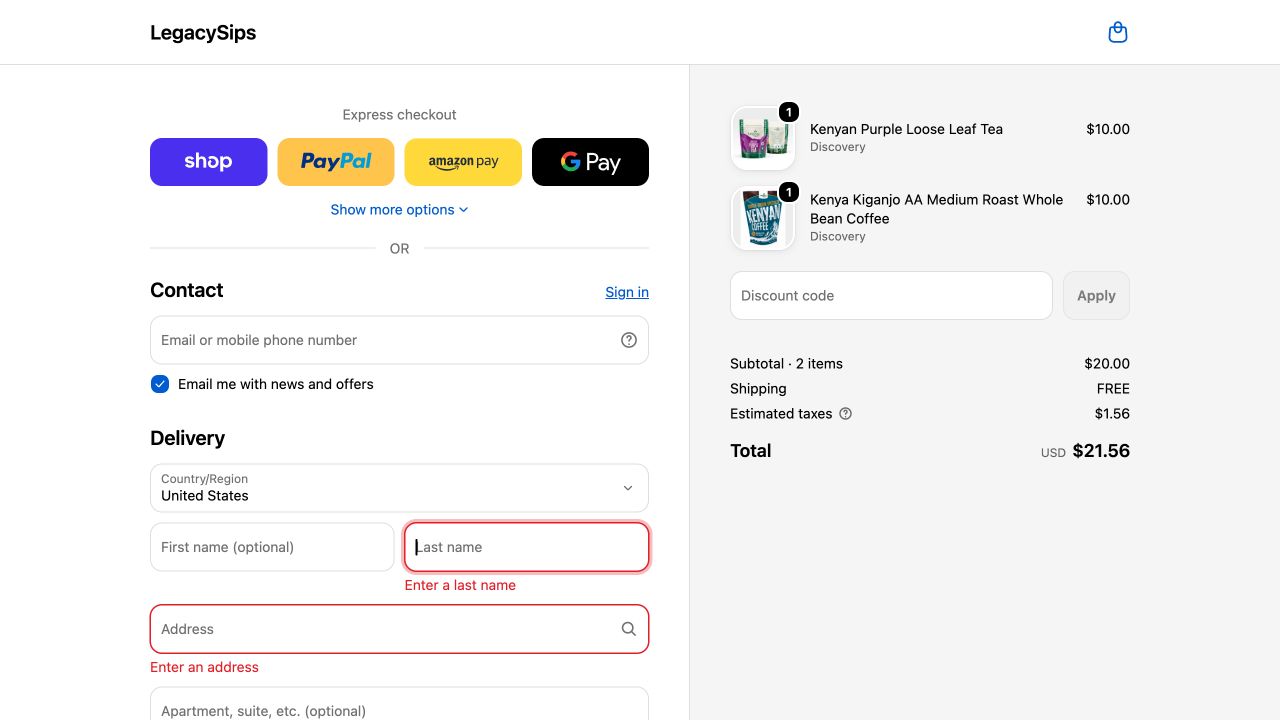
Figure 1 Mixed coffee and tea checkout quote on October 1 2026
Primary evidence
Mbugua email dated September 26 2026 Abandoned Checkout Summary (private source)
LegacySips homepage Featured reviews shipping claim and product excerpts
LegacySips Shipping and Returns Blank shipping section and unfinished return address
Kenya Kiganjo AA coffee Purchase area and description
Kenyan Purple Loose Leaf Tea Size and subscription selections
Site findings were checked in the live browser on October 1. GA4 configuration was read from the storefront’s script elements. The email is a private source and its mailbox link is omitted from this web report. Checkout session URLs are intentionally omitted because they contain temporary session identifiers.
Official technical references
Shopify Help Center Setting up Google Analytics 4
Google Analytics Help Monitor events in DebugView
These references support the recommended verification method. They do not establish that LegacySips currently receives every configured event. Proposed commercial edits are recommendations based on the observed pages; their conversion effect must be measured.